Vapi pricing starts with one number on the pricing page: $0.05 a minute. That number is real, and it is not what a minute costs you. It is the platform fee, and every call also pays for transcription, the language model, the voice and usually the phone line.
Vapi pricing is usage based: a $0.05 per minute platform fee plus the cost of the transcriber, language model, voice and telephony you choose. With common providers, a full minute lands at roughly $0.08 to $0.14, before the CRM and follow-up around the call.
My agency built on Vapi while scaling past $50K a month, so I know where the bill comes from. Every price below is from vapi.ai/pricing, checked 15 October 2026.
What one Vapi minute is made of
| Line | What it is | Price per minute |
|---|---|---|
| Platform hosting | Vapi's own fee | $0.05 |
| Transcriber | Speech to text (Deepgram) | $0.0095 to $0.0099 |
| Model | The LLM (OpenAI) | $0.0077 to $0.0452 |
| Voice | Text to speech (ElevenLabs) | $0.0146 to $0.0238 |
| Telephony | Vapi telephony, SIP or WebRTC | $0 |
| Twilio | $0.008 inbound, $0.014 outbound | |
| Vonage | $0.00814 | |
| Telnyx | $0.0055 |
Provider costs are passed through at cost. The ranges depend on the model and voice you pick.
Where the money goes in an expensive minute (Twilio outbound, top-of-range model and voice)
- Platform fee$0.050
- Model$0.045
- Voice$0.024
- Phone$0.014
- Transcriber$0.010
The real range
- Cheap minute: $0.05 platform + $0.0095 transcriber + $0.0077 model + $0.0146 voice + $0 Vapi telephony = about $0.082.
- Expensive minute: $0.05 + $0.0099 + $0.0452 + $0.0238 + $0.014 Twilio outbound = about $0.143.
Vapi's own example puts 1,000 minutes a month at $82 to $129, including the $50 hosting fee, which matches the range before phone charges.
The single biggest line is usually the platform fee itself. The model is next, and it is the line you control most: a smaller model can cut it by more than 80%, at the cost of how well the agent handles hard conversations.
Vapi plans and add-ons
| Plan | Price | Concurrent calls | Support |
|---|---|---|---|
| Starting tier | $0 to start, $5 free credits | 4 | Community and email |
| Core | $29 a month | 10 | Email, 2 business day response |
| Pro | 10% of the hosting fee, $999 a month minimum | 30 | Email and dedicated Slack, 1 business day response |
| Premier | Custom | Custom | Named support team |
Add-ons: HIPAA compliance at $2,000 a month, extra concurrency at $10 per line a month, and extra organizations at $20 each a month.
Concurrency is the hidden ceiling. Four concurrent calls is fine for testing. An outbound campaign or a busy inbound line needs Core or more, plus extra lines.
What Vapi costs at three volumes
Using the cheap and expensive minutes above ($0.082 and $0.143), before any plan fee:
| Monthly minutes | Cheap minute | Expensive minute |
|---|---|---|
| 500 | $41 | $72 |
| 2,000 | $164 | $286 |
| 10,000 | $820 | $1,430 |
Add the plan you need for concurrency: the starting tier allows 4 concurrent calls, Core ($29 a month) allows 10, and extra lines are $10 each a month. A busy inbound line or any outbound campaign usually needs Core or more.
Monthly Vapi cost at 2,000 minutes, cheap vs expensive minute
- Cheap$164
- Expensive$286
How to lower your Vapi bill
- Right-size the model. The model line ranges from under a cent to about 4.5 cents a minute. Routine booking and FAQ calls rarely need the top model; test a smaller one against your scenarios.
- Use Vapi's own telephony where it fits. Vapi telephony, SIP and WebRTC show at $0 a minute, against $0.008 to $0.014 for Twilio.
- Pick the voice deliberately. Premium voices cost more per minute; use them where callers notice.
- Do not pay for voicemail. Turn on voicemail detection for outbound so the agent drops a message or hangs up instead of talking to a machine.
- Keep turns short. Long answers mean more generated speech and more minutes on every call.
- Size concurrency to real peaks, not worst-case guesses, and add lines only when calls queue.
Vapi vs Retell vs Bland pricing at a glance
| Vapi | Retell | Bland | |
|---|---|---|---|
| Platform fee | $0.05 a minute | $0.055 a minute (voice infra) | Included in talk time |
| Model, voice, transcription | Passed through at cost | Priced per minute by choice | Included in $0.12 to $0.14 a minute |
| Telephony | $0 on Vapi numbers; Twilio $0.008 to $0.014 | $0.015 on Retell's Twilio; SIP free | Billed separately |
| Free concurrency | 4 calls | 20 calls | 10 calls (Start) |
| Monthly plans | Core $29; Pro from $999 | Pay as you go; Enterprise | Start $0; Build $299 |
Sources: each vendor's pricing page, checked October 2026. For the full picture of each, read the Retell AI review and the Bland AI review.
What Vapi pricing leaves out
Vapi bills the voice layer. A voice agent that makes money for a business needs more than the call:
- A CRM to know who is calling and to record what happened.
- Booking into a real calendar.
- Follow-up by text when the lead does not answer.
- Workflows that act on the call result: move the deal, tag the contact, start the next step.
- Campaign logic for outbound: calling hours by timezone, retries, voicemail, do-not-call checks.
Each of those is another tool, and the glue between them is another cost. I walk through what that glue looks like in how to connect Vapi to GoHighLevel.
Keep your Vapi agents, run them inside StrideOps
You do not have to choose between Vapi and a platform. In StrideOps you paste your Vapi API key under Settings > Integrations, and your existing Vapi assistants and phone numbers show up in StrideOps and stay in sync. Edits you make in StrideOps are pushed back to Vapi.
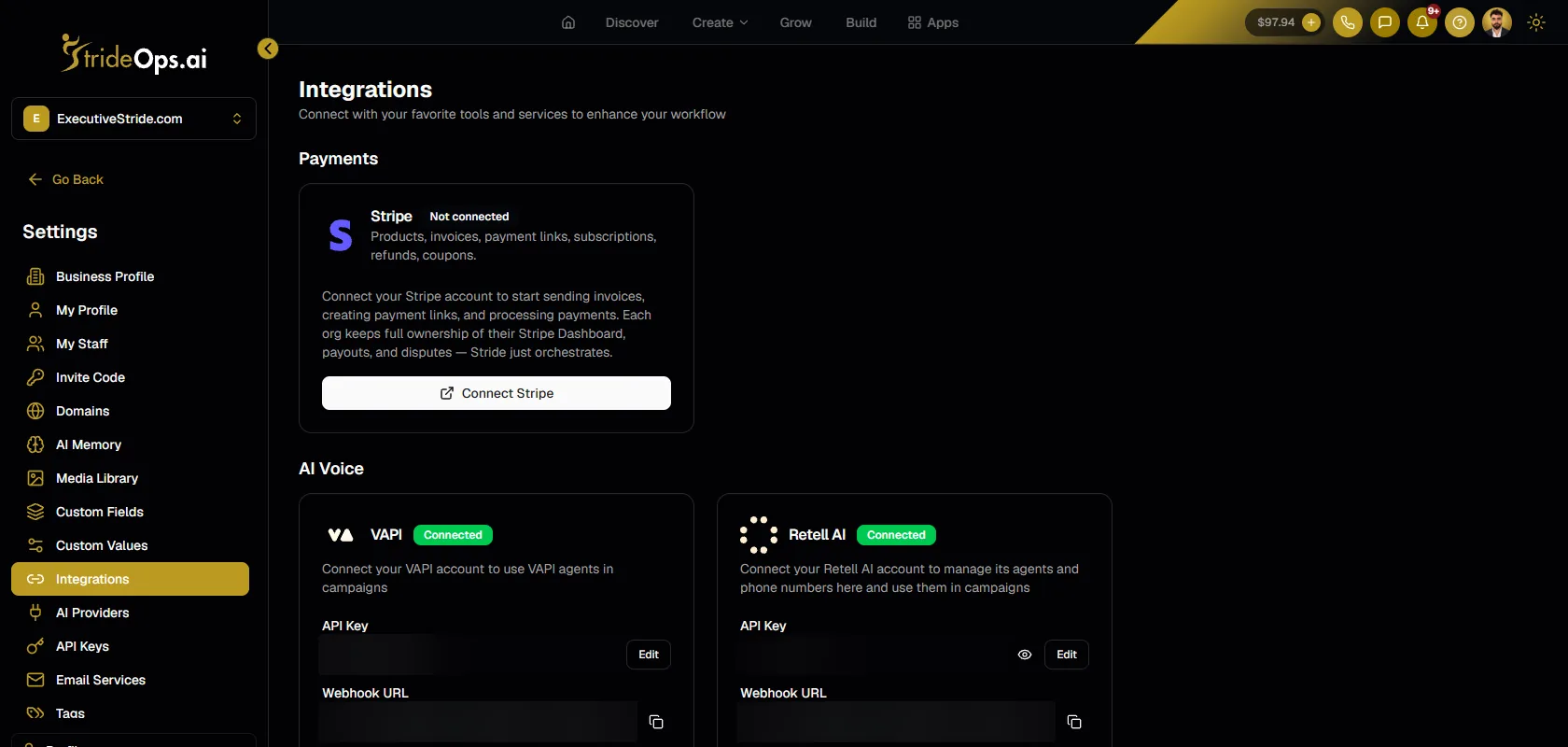
From there, Vapi agents run in StrideOps calling campaigns, with calling-hours windows, retries, voicemail drop and do-not-call checks, and every call gets an outcome that can update the CRM and start the next step. Vapi call events also trigger StrideOps workflows directly. Your Vapi usage stays on your Vapi account.
If you would rather drop the separate voice bill, StrideOps also runs native voice agents, metered against your plan's usage credits based on the real cost of each call. For the side-by-side with Vapi's closest rival, read Vapi vs Retell.
FAQ
How much does Vapi cost per minute?
Vapi charges a $0.05 per minute platform fee plus provider costs for transcription, the language model, the voice and telephony. With common providers, a full minute costs roughly $0.08 to $0.14.
Is Vapi free?
Vapi has a $0 starting tier with $5 of free credits and up to 4 concurrent calls. Real usage is billed per minute, and paid plans start at $29 a month for more concurrency and support.
Why is my Vapi bill higher than $0.05 a minute?
The $0.05 is only Vapi's platform fee. Each minute also pays for the transcriber, the language model, the voice and phone charges, which together can more than double the cost of a minute.
What are alternatives to Vapi?
Retell is the closest alternative for developers building voice agents. Platforms like StrideOps run voice agents inside a CRM with workflows and campaigns, and can also run your existing Vapi agents.
Does Vapi charge for phone calls?
Vapi's own telephony, SIP and WebRTC show at $0 a minute on its pricing page. Twilio, Vonage and Telnyx numbers are passed through at their per-minute rates.
What does the Vapi Core plan include?
Core is $29 a month and raises concurrency to 10 calls, with email support and a two business day response time.
The bottom line
Budget Vapi at about $0.08 to $0.14 a minute with common providers, not $0.05, and pick a plan for the concurrency you actually need. Then price the parts Vapi does not cover. If those parts are the expensive bit, run your Vapi agents inside a platform that already has them. See voice agents in StrideOps.
Keep your Vapi agents. Add everything around the call.
Connect your Vapi account and run your agents in campaigns and workflows, with the CRM, booking and follow-up built in.
About the author

Josh Pocock
Founder & CEO, StrideOps.ai
Josh Pocock is the founder and CEO of StrideOps.ai. He spent eight years building sales and marketing companies - most recently Executive Stride, the AI appointment-setting agency that now runs end to end on StrideOps.ai as customer zero. He went all-in on the platform full-time in late 2025.
Josh Pocock is the founder and CEO of StrideOps.ai. He scaled his own AI agency past $50K a month on GoHighLevel, Vapi and n8n, and his agency Executive Stride has built systems for 400+ businesses. StrideOps started as the platform he built to replace that stack.
Read more
After Hours AI Receptionist: Catch the Calls You Miss
After hours AI receptionist setup: answer every evening and weekend call, book the next open slot, route emergencies to on-call staff, and follow up by text.

AI Receptionist Pros and Cons: Is It Worth It?
AI receptionist pros and cons for small businesses: the real benefits, the real drawbacks, and a quick checklist to decide whether one is worth it for you.

AI Receptionist Script: A Copy-and-Paste Template
AI receptionist script template to copy: identity, greeting, the calls it handles, booking, FAQs, guardrails, transfers and the close, with example lines.