Short answer: in Vapi vs Retell, pick Vapi if you are a developer who wants to choose every piece of the voice stack yourself, wire multi-agent handoffs and manage agents as code. Pick Retell if you want to build and test agents from a dashboard, with node-based call flows and more concurrent calls included before you pay extra. On cost they land close together: both vendors' own examples come out around $0.08 to $0.13 a minute before phone charges.
My agency built client agents on both while I was scaling it past $50K a month, so this is not a feature-page summary. Both are good. They are good at different things, and the wrong pick shows up as friction months later, not on day one.
Every price below is from vapi.ai/pricing and retellai.com/pricing, and every feature from each vendor's docs, checked on 15 October 2026.
Vapi vs Retell at a glance
| Vapi | Retell | |
|---|---|---|
| How it describes itself | "The developer platform for building voice AI agents" | "A platform to build, test, deploy, and monitor AI voice and chat agents" |
| Platform fee | $0.05 a minute | $0.055 a minute (voice infrastructure) |
| Speech, model and voice | Passed through at provider cost, billed on top | Priced per minute from Retell's own list (voices from $0.015, models from $0.0016) |
| Vendor's own cost example | 1,000 minutes for $82 to $129 a month | $0.11 a minute |
| Concurrent calls included | 4 (10 on the $29 Core plan) | 20 |
| Extra concurrency | $10 per line a month | $8 per call a month |
| Free credits | $5 | $10 |
| Main building blocks | Assistants, squads, tools | Single prompt agents, conversation flow agents |
| Testing | Simulations and evals | Simulation testing, A/B testing |
| HIPAA | $2,000 a month add-on | Says it is HIPAA compliant; you sign the BAA yourself |
Pricing: closer than it looks
The two pricing pages are built differently, which makes them hard to compare at a glance.
Vapi charges a $0.05 a minute platform fee and passes everything else through at the provider's price: speech-to-text, the language model and the voice. Its own estimate for 1,000 minutes a month is $82 to $129: $50 of hosting, about $10 of transcription, $8 to $45 of model and $15 to $24 of voice. Calls on Vapi's own numbers, SIP and web calls carry no transport fee; Twilio adds $0.008 a minute inbound and $0.014 outbound. On top of usage there are plan tiers: no plan fee to start, Core at $29 a month, and Pro at 10% of hosting with a $999 monthly minimum.
Retell prices every layer itself. Voice infrastructure is $0.055 a minute, voices run from $0.015 a minute up to $0.10 for premium ElevenLabs models, and the language model ranges from fractions of a cent to $0.64 a minute depending on which one you pick. Telephony on Retell numbers is $0.015 a minute, and SIP trunking carries no Retell charge. Its headline range is $0.07 to $0.31 a minute, and its worked example lands at $0.11.
Each vendor's own example, cost per 1,000 minutes
- Vapi (low)$82
- Retell example$110
- Vapi (high)$129
The honest takeaway: the model and the voice you choose move the bill far more than the platform fee. A premium voice and a frontier model will cost more on either platform.
Where the bill surprises people
- Concurrency. Vapi includes 4 concurrent calls on its free tier and 10 on Core, then $10 per extra line a month. Retell includes 20, then $8 per extra call a month. If you run outbound campaigns, this matters more than the per-minute rate.
- Add-ons. Retell charges per minute for extras like knowledge base retrieval ($0.005), PII removal ($0.01) and AI quality assurance after the first 100 free minutes ($0.10). Batch calls add $0.005 a dial.
- Compliance. Vapi sells HIPAA as a $2,000 a month add-on. Retell says it is HIPAA compliant and lets you sign the BAA yourself.
Building agents: code first vs dashboard first
This is the real difference, and it is why my team used both.
Vapi is built for developers. The core unit is an assistant: a prompt, tools and structured outputs, with your choice of transcriber, model and voice provider. Squads let several assistants hand a call to each other while keeping the context. There are SDKs for putting voice in your own app, a long list of SIP integrations, and a config-as-code workflow for managing assistants, squads, tools, simulations and evals in git. Vapi also has a dashboard and an AI builder called Composer, but the platform rewards people who are comfortable with APIs.
Retell is built for builders who live in the dashboard. You start with a single prompt agent, and when you need tighter control you switch to a conversation flow agent: a graph of nodes for dialogue, function calls, code, logic splits, transfers, keypad presses, SMS and MCP tools. It has ready-made tools for HubSpot, Salesforce, Zendesk and Cal.com, built-in post-call analysis, and an AI copilot called Conductor that helps you build and test.
Neither is better. Vapi gives developers more knobs; Retell gives operators a faster path from idea to a tested agent.
Testing before customers hear it
Both take testing seriously.
- Vapi has simulations and evals, and its path-to-production guide has you test with simulations before going live and monitor calls after.
- Retell has simulation testing with graded test cases, a playground where an AI plays the caller, and A/B testing that splits live traffic between two agents or prompts.
Whichever you pick, use it. Every agent I shipped without a test set broke on a caller nobody had imagined.
Phone numbers and telephony
- Vapi gives you a free US number to start, imports numbers from Twilio, Vonage and Telnyx, and documents SIP trunking with a long list of carriers.
- Retell sells US and Canadian numbers ($2 a month on its pricing table) or connects your own carrier over SIP trunking, with branded and verified caller ID as paid extras.
So which one should you build on?
Choose Vapi if:
- You have developers and want to pick the transcriber, model and voice per agent.
- You need multi-agent handoffs (squads) or want agents versioned in git.
- You are building voice into your own product with SDKs.
Choose Retell if:
- You want non-developers to build and edit agents in a visual flow.
- You run outbound volume and want 20 concurrent calls before paying more.
- You need HIPAA without a $2,000 a month add-on.
The part neither one does
Here is what I learned running both at an agency: the voice platform was never the hard part. The hard part was everything around the call. Which leads get called, when, and how often. What happens when nobody answers. Where the outcome goes, and what fires next. Neither Vapi nor Retell is a CRM, a dialer with calling rules, or an automation builder, so every client build had webhooks, an n8n flow and a CRM on the end of it.
That is the gap StrideOps fills, and you do not have to give up either platform to use it:
- Connect either one with an API key. In Settings > Integrations, paste your Vapi or Retell key. Your agents and phone numbers show up in StrideOps and stay in sync.
- Run them in calling campaigns. When you create a campaign you pick the provider: StrideOps native, Vapi or Retell. The campaign handles calling hours by contact timezone, retries, voicemail and do-not-call checks, and every call gets an outcome that moves the deal or starts the next step.
- Call events fire workflows. Vapi and Retell call started, ended and analyzed events trigger StrideOps workflows directly, with no server URL or n8n flow in the middle.
Your Vapi or Retell agent, run from a StrideOps campaign

Contacts in the CRM
A list, a smart list or a pipeline stage
Calling campaign
Hours, retries, voicemail and do-not-call checks

Your Vapi or Retell agent
Picked as the campaign's provider
Outcome and next step
Booked, no answer, voicemail or callback
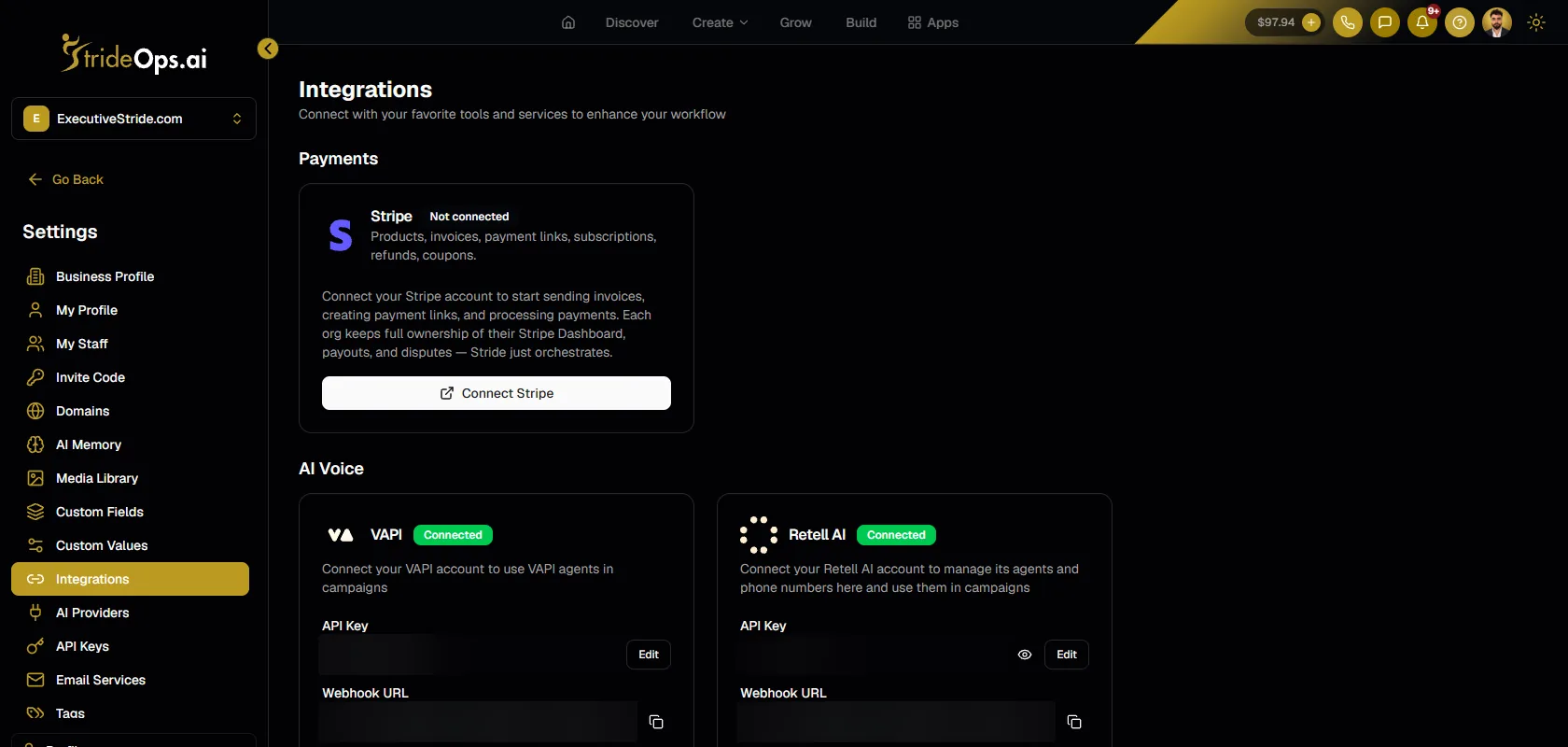
Two honest limits. Retell tools live inside Retell and are not synced into StrideOps, and pointing a phone number at a Retell agent needs SIP trunk setup on the Retell side. Pointing a Twilio number at a Vapi agent is set up for you. And if you want a lead called the second a form comes in, the workflow "AI outbound call" step dials StrideOps native agents on Twilio numbers; Vapi and Retell agents run through campaigns.
So the choice is not permanent. Start on whichever fits your team today, and if you outgrow it, connect the other one and run both from the same campaigns. Or build natively in StrideOps with your choice of speech, model and voice providers. See how it works on the voice agents page, or read the full Vapi and Retell comparisons.
FAQ
The bottom line
Vapi and Retell cost about the same. The difference is who builds: Vapi suits developers who want control of every layer, Retell suits teams who want to build and test from a dashboard. Whichever you pick, plan for what happens around the call, because that is where the real work is.
Keep your agents. Add the campaigns.
Connect your Vapi or Retell account and run your existing agents in calling campaigns and workflows, with every outcome on the contact.
About the author

Josh Pocock
Founder & CEO, StrideOps.ai
Josh Pocock is the founder and CEO of StrideOps.ai. He spent eight years building sales and marketing companies - most recently Executive Stride, the AI appointment-setting agency that now runs end to end on StrideOps.ai as customer zero. He went all-in on the platform full-time in late 2025.
Josh Pocock is the founder and CEO of StrideOps.ai. He scaled his own AI agency past $50K a month on GoHighLevel, Vapi and n8n, and his agency Executive Stride has built systems for 400+ businesses. StrideOps started as the platform he built to replace that stack.
Prices from vapi.ai/pricing and retellai.com/pricing, features from docs.vapi.ai and docs.retellai.com, all checked 15 October 2026. Vendors change prices and features, so check before you build.Read more
After Hours AI Receptionist: Catch the Calls You Miss
After hours AI receptionist setup: answer every evening and weekend call, book the next open slot, route emergencies to on-call staff, and follow up by text.

AI Receptionist Pros and Cons: Is It Worth It?
AI receptionist pros and cons for small businesses: the real benefits, the real drawbacks, and a quick checklist to decide whether one is worth it for you.

AI Receptionist Script: A Copy-and-Paste Template
AI receptionist script template to copy: identity, greeting, the calls it handles, booking, FAQs, guardrails, transfers and the close, with example lines.