Learning how to qualify leads with AI is mostly about deciding what "qualified" means before any AI is involved. The AI is good at asking the same questions politely to every lead, at any hour. It cannot fix a qualification process nobody wrote down.
To qualify leads with AI, write down the three to five facts that make a lead worth your team's time, turn each into one plain question, let an AI voice or text agent ask them the moment the lead arrives, then route qualified leads to a booking and the rest to nurture.
Here is the process, from criteria to routing.
Step 1: define qualified in writing
Pick the few facts that decide whether a lead is worth a salesperson's time. A common starting point is the BANT set:
| Criterion | The question behind it |
|---|---|
| Budget | Can they afford what you sell? |
| Authority | Are they the person who decides, or will someone else? |
| Need | Do they have the problem you solve, now? |
| Timing | When do they want it solved? |
Add anything specific to your business: service area, property type, insurance status, team size. Keep the list to five at most. Every extra question costs you leads who hang up.
Step 2: turn each criterion into one plain question
Leads do not answer "What is your budget?" well. They answer questions about their situation:
- Budget: "Have you priced this out before, or is this your first look?"
- Authority: "Is anyone else involved in the decision?"
- Need: "What made you reach out today?"
- Timing: "When are you hoping to have this sorted?"
- Area: "What's the zip code for the property?"
Step 3: let the AI ask, the moment the lead arrives
Qualification works best in the first minutes, while the lead is still engaged. An AI voice agent can call as soon as a form, funnel or Facebook lead comes in; an AI text agent can text first for leads who prefer it. See how to call Facebook leads automatically.
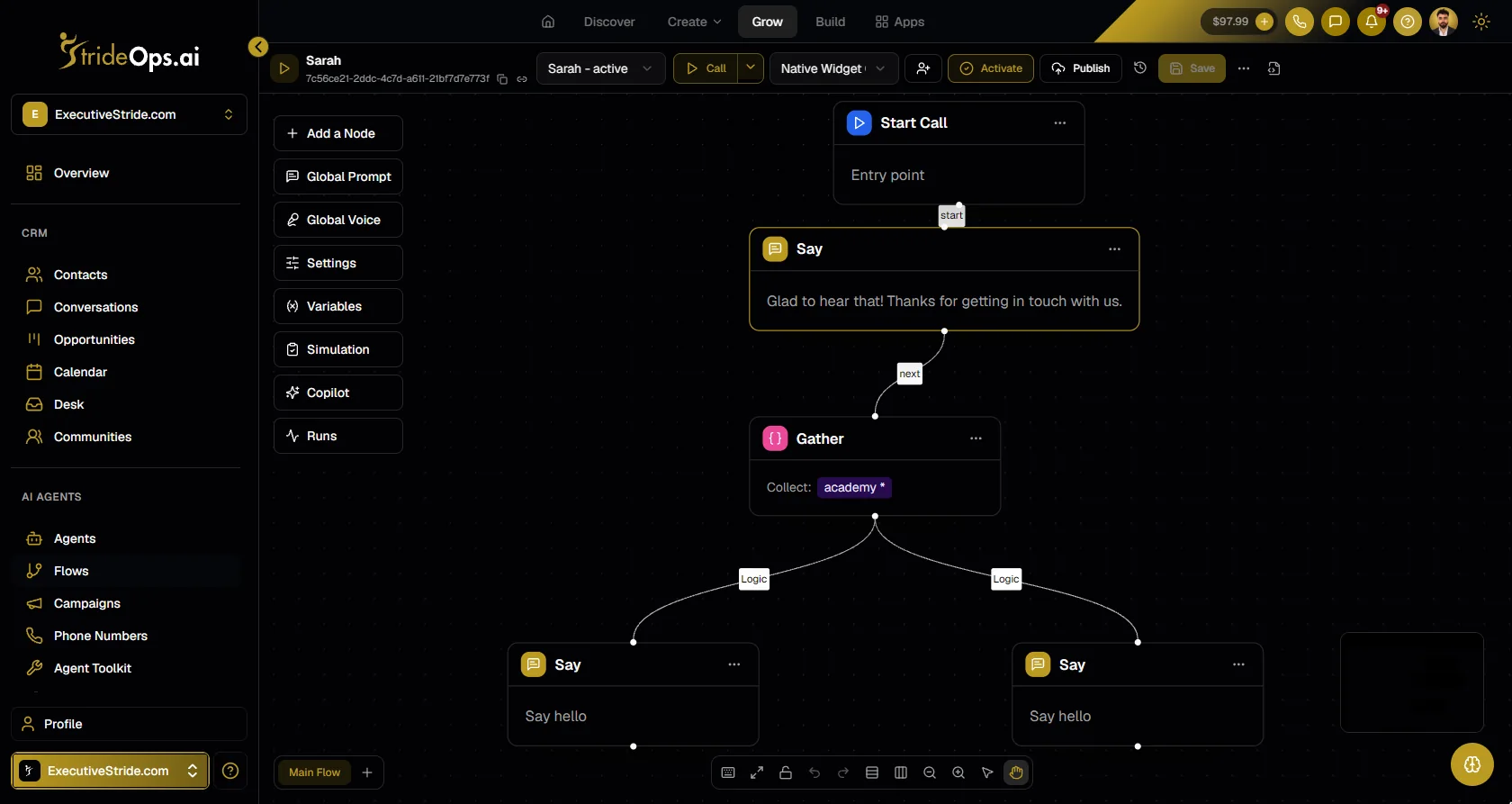
For qualification, structure beats a free-form prompt. Map the call as steps: ask, listen, branch on the answer.
Step 4: route every outcome
Qualification is only useful if the answer changes what happens next.
One lead, three paths

New lead
Form, funnel or Facebook lead

AI asks the questions
By call or text, right away
Qualified: booked
On the calendar during the conversation
Not yet: nurture
Tagged and followed up later
- Qualified: book them during the conversation. A qualified lead who has to wait for a callback is a lead someone else books.
- Not yet: tag them with the reason (timing, budget) and put them in a nurture sequence that follows up when the timing changes.
- Not a fit: thank them, tag them and stop. Wasting their time is worse than losing them.
Step 5: review and tighten
Read or listen to the first 30 qualification conversations. Look for questions that confuse people, answers the AI misread, and qualified leads it let go. Adjust the questions, not just the prompt.
Turn answers into hot, warm and cold
Decide in advance what each combination of answers means and where it goes:
| Answers | Status | Next step |
|---|---|---|
| Clear need, timing within a month, decision maker | Hot | Book now, during the conversation |
| Clear need, timing in one to six months | Warm | Book a later call or nurture with a check-in date |
| Researching, no timing, or outside your area | Cold | Thank them, tag the reason, light nurture |
| Not a fit (wrong service, wrong market) | Disqualified | Thank them and stop |
Example: qualifying by text
AI text agent: Thanks for reaching out to Coastline Solar. Quick question so we send the right info: do you own the home?
Lead: Yes.
AI text agent: Great. Roughly what's your average monthly electric bill?
Lead: Around $220.
AI text agent: Thanks. Are you hoping to go solar this year?
Lead: Ideally before summer.
AI text agent: Perfect. I can book a free 20-minute consultation. Tuesday at 4 or Wednesday at 11?
Three questions, one booking, and the lead never filled in another form.
Disqualify politely
When a lead is not a fit, end well; they may refer someone who is:
- "Thanks for telling me. That's outside what we do, but [type of business] would be a good fit."
- "We don't cover your area yet. Can I let you know if that changes?"
How this works in StrideOps
- AI voice agents call new leads from a workflow the moment they arrive and can follow a Voice Flow of say, gather and branch steps. The recording and transcript land on the contact.
- AI text agents ask the same questions by text, collect name and email, tag contacts, trigger workflows and book from live availability.
- Calling campaigns end every call with an outcome (booked, no answer, voicemail, callback) and a disposition map that decides the next step.
- Shared memory, when turned on, means the voice agent knows what the lead already said by text, so nobody asks a question twice.
See AI workflows and speed to lead for the full setup.
FAQ
What is AI lead qualification?
AI lead qualification is using an AI voice or text agent to ask new leads a set of qualifying questions, such as need, budget, authority and timing, then booking qualified leads and routing the rest to nurture automatically.
How do I qualify a lead?
Decide the few facts that make a lead worth your time, ask each as one plain question, and route the lead based on the answers: book the qualified ones now and follow up with the rest when their timing changes.
How many qualifying questions should you ask?
Three to five. Each extra question increases the chance the lead drops off, so keep only the ones that change what you do next.
Can AI qualify leads by text as well as by phone?
Yes. An AI text agent can ask the same questions by SMS, book qualified leads and hand off to a call when the lead asks for one.
What questions should an AI ask to qualify a lead?
Ask about the need (what made them reach out), the timing (when they want it solved), the decision (who else is involved) and any fit criteria such as service area or budget range. Three to five questions is enough.
Should qualification happen by phone or text?
Both work. Calls convert faster for leads who answer; text suits leads who prefer it and reaches people during the day. Use the same questions in both so the answers are comparable.
What happens to leads that are not qualified yet?
Tag them with the reason and put them in a nurture sequence with a check-in date, so they come back when their timing or budget changes.
The bottom line
AI makes qualification fast and consistent, but only if you decide what qualified means first. Write down a few criteria, ask them as plain questions the moment the lead arrives, and make every answer route the lead somewhere. Your team spends its time on the leads who are ready.
Qualify every lead the moment it arrives
AI calls and texts that ask your questions, book the qualified leads on your calendar and route the rest, inside your CRM.
About the author

Josh Pocock
Founder & CEO, StrideOps.ai
Josh Pocock is the founder and CEO of StrideOps.ai. He spent eight years building sales and marketing companies - most recently Executive Stride, the AI appointment-setting agency that now runs end to end on StrideOps.ai as customer zero. He went all-in on the platform full-time in late 2025.
Josh Pocock is the founder and CEO of StrideOps.ai. He scaled his own AI agency past $50K a month, and his agency Executive Stride has built systems for 400+ businesses. StrideOps started as the platform he built to replace that stack.
Read more
AI SMS Follow Up for Leads: What to Automate
AI SMS follow up for leads, done right: the texts to automate, the moments to hand to a person, and how text and calls work as one rep.
How to Call Facebook Leads Automatically in Under a Minute
Call Facebook leads automatically in under a minute: connect your Page, map lead forms and build one workflow that has an AI agent call every new lead.
Speed to Lead: Why the First Minutes Decide the Deal
Speed to lead is how fast you reach a new lead after they raise their hand. What the research says, why human teams miss the window and how AI closes it.