AI voicemail drop for sales solves a simple problem: most outbound calls reach voicemail, and reps waste hours leaving the same message over and over. Dropping a recorded message the moment a machine answers gives that time back. The catch is that "voicemail drop" means two different things, and the law treats them the same way.
AI voicemail drop for sales means an AI dialer detects that a voicemail box answered and leaves a pre-recorded message automatically, then moves on. Ringless voicemail skips the ring entirely. Under the FCC's 2022 ruling, ringless voicemail to mobile phones counts as a call, so both need proper consent.
Here is how each works, what is legal, and how to write a drop that actually gets a callback.
Voicemail drop vs ringless voicemail
| Voicemail drop | Ringless voicemail | |
|---|---|---|
| Does the phone ring? | Yes, it is a normal call | No, the message lands in the voicemail box directly |
| When the message plays | After voicemail detection hears a machine answer | Delivered straight to the mailbox |
| Typical use | Inside an outbound calling campaign, when nobody picks up | As its own campaign step or channel |
| Consent rules | Treated as a call | Also treated as a call (FCC, 2022) |
Is voicemail drop legal?
In the US, the Telephone Consumer Protection Act (TCPA) restricts calls that use an artificial or prerecorded voice. In November 2022, the FCC issued a declaratory ruling that ringless voicemails to wireless phones are calls under the TCPA, which means they require the consumer's prior consent, the same as other prerecorded calls. Pre-recorded voicemail drops after a ring are calls too. Separately, the FCC confirmed in 2024 that AI-generated voices count as artificial voices under the TCPA.
In practice:
- Get the right consent before sending prerecorded messages to mobile phones, especially for marketing.
- Scrub against do-not-call lists and honor opt-outs immediately.
- Identify your business in the message and give a way to call back or opt out.
This is not legal advice. Read is AI cold calling legal for more on consent, and check the rules where you sell.
What to say in a 20-second voicemail
Short, specific and easy to act on. A voicemail drop that sounds like an ad gets deleted in three seconds.
Hi [first name], it's [your name] from [business].
You asked about [what they inquired about] on [when/where].
I've got a couple of times open this week to walk you through it.
Call or text me back at [number], that's [number again].
Thanks, [first name].
Rules that keep it working:
- Under 30 seconds. Most people decide in the first few.
- Reference their inquiry. "You asked about a solar quote last week" beats a generic pitch.
- One action. Call or text back, with the number said twice.
- Sound like a person. Record it the way you would leave it for a colleague, not read from a script.
How to use voicemail drops in a campaign
Voicemail works best as one step in a sequence, not as the whole campaign:
Where the voicemail drop fits in a calling campaign

AI calls the lead
Inside their calling hours

Machine answers
Voicemail detection hears it
Drop the message
Your recorded voicemail, then hang up
Text follow-up
Same offer, in writing
- Call first. A live conversation is always the goal; the drop is the fallback.
- Pair it with a text. The voicemail gives context, the text gives a one-tap way to reply.
- Cap the attempts. One voicemail per lead per few days is plenty; more starts to feel like spam.
Three voicemail templates
Inbound lead who did not answer the first call:
Hi [first name], it's [name] from [business]. You asked about [service] a few minutes ago. I'll text you two times that work for a quick call; just reply with the one you like. Talk soon.
Reactivating an older lead:
Hi [first name], it's [name] from [business]. You looked into [service] with us back in [month]. If it's still on your list, I've got openings this week. Call or text me at [number], that's [number]. Thanks.
Missed appointment:
Hi [first name], it's [name] from [business]. We missed you at your [time] appointment today, no problem at all. Reply to the text I'm sending and we'll find a new time.
Each one references something specific, asks for one action and pairs with a text.
Voicemail detection: what to know
Voicemail detection listens to the first seconds of the answer to tell a person from a machine. It is good, not perfect:
- Long or unusual greetings can be misread as a person, and a short "hello?" can occasionally be misread as a machine.
- Test it on your own list with a small batch first, and listen to a sample of calls where a voicemail was dropped.
- Keep the drop short, so a false detection does not leave a long recording playing to a confused person.
What to measure
| Number | Healthy sign |
|---|---|
| Callbacks and text replies after a drop | Rising as messages get more specific |
| Opt-out requests | Low; a spike means the list or message needs work |
| Booked appointments per 100 drops | Your real measure of whether the drop earns its place |
How this works in StrideOps
StrideOps calling campaigns run the sequence above. The AI calls inside each lead's calling hours with retries and double-dial, and when a voicemail picks up, voicemail detection can drop your recorded message and end the call. Ringless voicemail is available as its own campaign channel alongside voice, SMS and email, and do-not-call and do-not-disturb checks run before every dial.
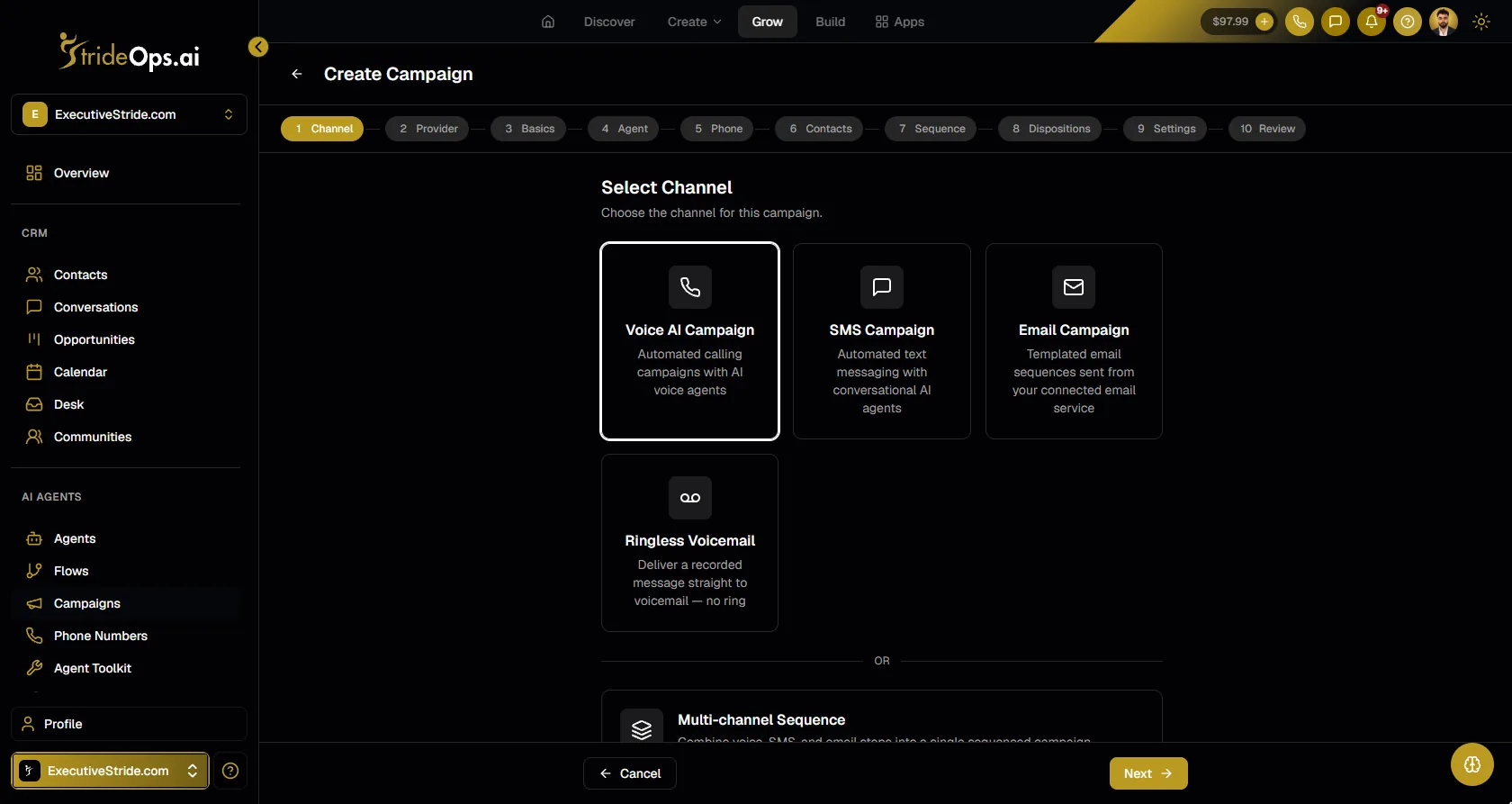
Every call ends with an outcome (booked, no answer, voicemail, callback), and a disposition map decides what happens next, such as a follow-up text. See AI calling campaigns.
FAQ
Is voicemail drop illegal?
Voicemail drops are legal when you follow the rules for prerecorded calls. In the US, the FCC ruled in 2022 that ringless voicemails to mobile phones are calls under the TCPA, so you need proper consent, must honor do-not-call lists and should identify your business.
Do voicemail drops work?
They work best as part of a sequence: a call attempt, a short personal voicemail that references the lead's inquiry, and a text follow-up. Generic, salesy drops get deleted.
What is the difference between voicemail drop and ringless voicemail?
A voicemail drop plays a recorded message after the call rings and reaches voicemail. Ringless voicemail delivers the message to the voicemail box without the phone ringing.
How long should a sales voicemail be?
Under 30 seconds. Say who you are, reference what they asked about, give one action and repeat your number.
Can an AI voice leave voicemails?
Yes. A pre-recorded message can be dropped automatically when a machine answers, and AI voice agents can be configured to handle voicemail. Under the TCPA, artificial and AI-generated voices are treated as artificial voices, so consent rules apply.
Should I leave a voicemail on every call attempt?
No. One voicemail per lead every few days is plenty. Pair it with a text and let retries without a voicemail fill the gaps.
The bottom line
Voicemail drops give reps back the hours they spend leaving the same message, and ringless voicemail adds a channel that does not interrupt anyone. Both are calls in the eyes of the law, so get consent first. Then keep the message short, specific and paired with a text, and let the campaign handle the rest.
Call, drop the voicemail, text the follow-up
AI calling campaigns with voicemail detection and drop, ringless voicemail as a channel, and do-not-call checks before every dial.
About the author
Josh Pocock
Founder & CEO, StrideOps.ai
Josh Pocock is the founder and CEO of StrideOps.ai. He spent eight years building sales and marketing companies - most recently Executive Stride, the AI appointment-setting agency that now runs end to end on StrideOps.ai as customer zero. He went all-in on the platform full-time in late 2025.
Josh Pocock is the founder and CEO of StrideOps.ai. He scaled his own AI agency past $50K a month, and his agency Executive Stride has built systems for 400+ businesses. StrideOps started as the platform he built to replace that stack.
FCC ringless voicemail ruling: Declaratory Ruling and Order FCC 22-85 (CG Docket 02-278), November 21, 2022. Not legal advice.Read more
How to Reactivate Old Leads With AI Calls and Texts
How to reactivate old leads with AI: segment the list, check consent, run a multichannel campaign of calls, texts and voicemail, and route every outcome.
Is AI Cold Calling Legal? TCPA Rules for AI Voice (2026)
Is AI cold calling legal? What the FCC's 2024 ruling means for AI voice calls, the consent you need, and the calling rules to follow. Not legal advice.
Can an AI SDR Book Meetings? What Outbound AI Can Do
An AI SDR can book meetings from warm leads at a pace no team can match. What outbound voice AI does well, where it fails and how to deploy it safely.