If you run a home services business, your hands are full, literally. You are under a sink, on a roof or in a crawlspace, and that is exactly when the phone rings with your next job. It goes to voicemail, and the homeowner with water on the floor calls the next plumber on the list.
AI voice agents for home services answer every call while you and your crew are on jobs. They book routine work into open windows on your calendar, spot emergencies and transfer them to whoever is on call, answer questions about your service area and pricing, and log every call to your CRM.
That is the core problem of every trade: the work that pays you is the work that stops you answering the phone that brings more work. For the fundamentals behind the technology, see the complete guide to AI voice agents.
The math of a missed call in the trades
Home services has an unusually high cost per missed call, for two reasons. The tickets are big: one HVAC install, repipe or panel upgrade can be worth thousands. And the intent is urgent. People do not call a plumber to browse. They call because something is broken, and they hire whoever picks up.
So a missed call is rarely just a missed call. It is a booked job that went to a competitor. The AI receptionist cost breakdown shows the general math; in the trades the numbers are bigger because the average ticket is bigger.
What an AI agent handles for a trades business
Sorts emergencies from routine calls
A "my water heater is leaking everywhere" call needs different handling from "I'd like a quote next month". You define what counts as urgent, and the agent sorts every call on the spot.
Every call, sorted while you stay on the job

Homeowner calls
Your business number, any hour

AI agent asks what is wrong
Problem, address, how urgent
Emergency: transfer
To the on-call tech, with a text summary

Routine: book a window
Real open slots on your calendar
For calls that must follow the same path every time (get the address, confirm the service area, then branch on urgency), map the call as steps in a visual call flow instead of one long prompt.
Books the routine work
For service calls and maintenance, the agent gets the address and the problem, offers a real appointment window from your calendar, and books it. The job is on the schedule before you have wiped your hands, and a workflow sends the confirmation and a reminder the day before.
Answers from your price list and service area
The agent answers from a knowledge base you write: service area, hours, trip fees, typical price ranges, and what you do and do not handle. If something is not in the knowledge base, it says it will have someone confirm instead of guessing.
Logs every lead in one place
Every call lands on a contact in the CRM with the recording and transcript. No more job details on sticky notes and half-heard voicemails.
Covers nights, weekends and overflow
Emergencies do not keep business hours, and neither does the agent. After-hours calls get answered, sorted and booked or transferred, instead of rolling to a voicemail you find on Monday.
Follows up on quotes and maintenance
The estimate you sent and never heard back on is money on the table. An AI calling campaign can follow up on open quotes and call past customers who are due for maintenance, inside calling hours, with retries and voicemail drop.
Route your number in one place
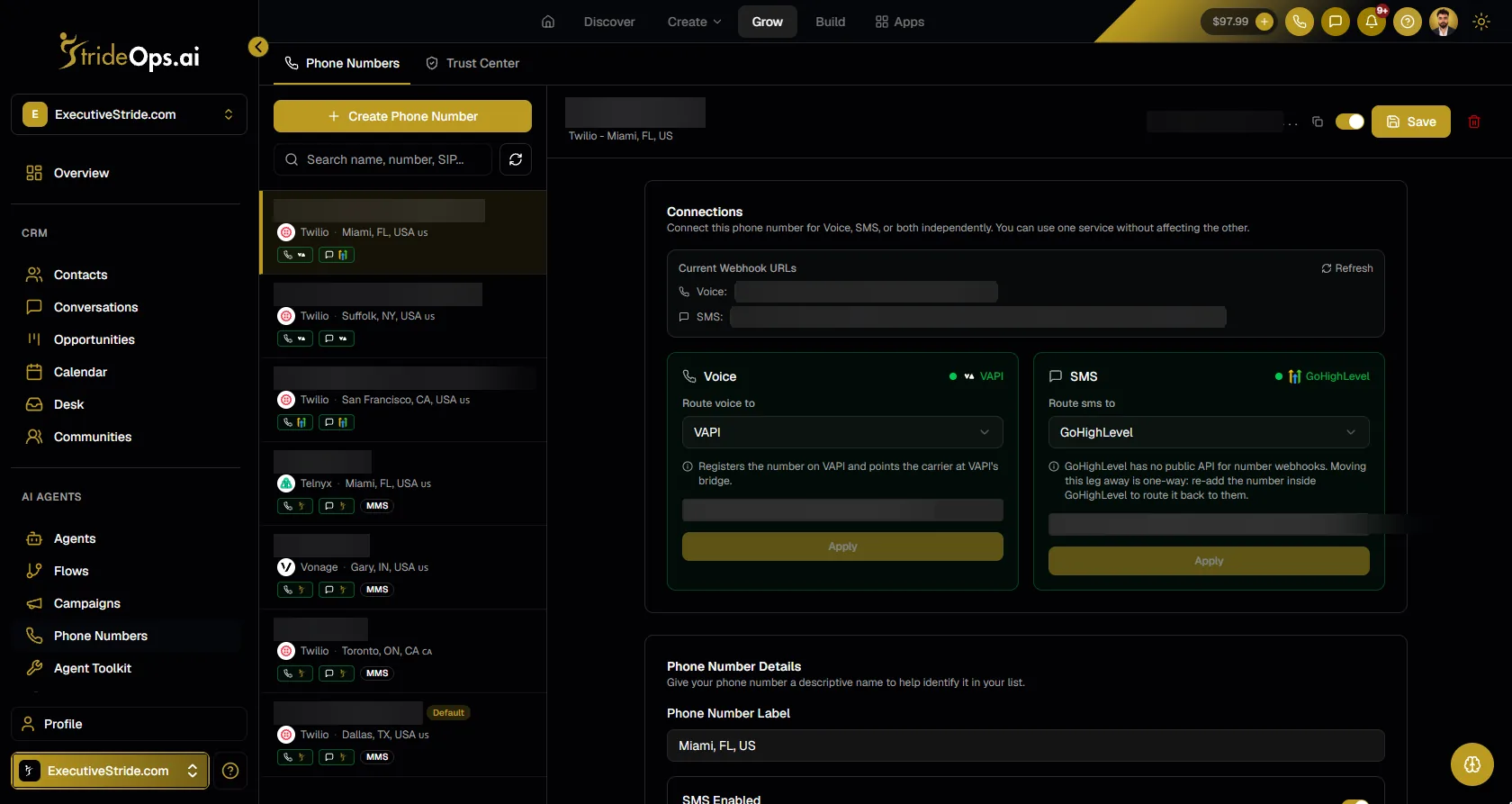
Point your business number at the agent. In StrideOps each number's voice and SMS legs route separately, so the same number can answer calls with the AI voice agent and texts with an AI text agent. Bring your own Twilio, Telnyx or Vonage numbers.
Why it has to sound right
Homeowners calling about an emergency are stressed, and a slow, clunky robot makes a bad moment worse and loses the job. The agent has to answer fast, sound calm and understand the problem. Test it against stressed, fast-talking and confused callers before it goes live; StrideOps runs simulated callers for exactly that. The voice AI latency guide explains what to measure.
An example call while you are on a job
AI: Thanks for calling Summit Plumbing, this is Ava. How can I help?
Caller: My water heater is leaking.
AI: Sorry about that. Is water spreading across the floor right now, or is it a small leak?
Caller: It's pooling a bit.
AI: Okay. If you can, turn off the water supply to the heater. I'm connecting you with our on-call plumber now and passing along what you've told me.
A routine call ("can someone look at a slow drain next week?") would have been booked straight onto the calendar instead.
What to put in the knowledge base
- Services and service area by town or zip code.
- Emergency list and on-call numbers, with any safety lines your team approves.
- Price ranges or call-out fees you publish, and the rule that quotes come after a visit.
- Booking rules: job types, arrival windows, travel time.
- Warranty and guarantee basics you publish, with disputes always transferred.
Roll it out in three weeks
- Week 1: after hours only. The AI covers evenings and weekends; the owner reads the transcripts each morning.
- Week 2: add working hours. Route calls to the AI while crews are on jobs.
- Week 3: AI first. The AI answers every call, books routine work and sends emergencies to on-call with a summary.
For trade-specific guides, see AI receptionist for cleaning businesses and AI receptionist for landscaping companies.
Mistakes to avoid
- No emergency list. "Urgent" means different things to different callers; write the list with your techs.
- Quoting jobs over the phone. Ranges and call-out fees only; quotes come after a visit.
- Booking without travel time. Leave gaps between jobs in your availability, or the calendar will not match the day.
- Forgetting the follow-up. Callers who do not book should get a text, and every booked job a confirmation.
FAQ
Can an AI voice agent tell an emergency from a routine call?
Yes. You define what counts as urgent, and the agent asks the questions to find out, then transfers emergencies to whoever is on call with a summary, and books routine work into open windows.
Will it know my service area and pricing?
It answers from a knowledge base you provide, so it can confirm your service area, hours, trip fees and typical price ranges, and what you do and do not handle, rather than guessing.
I'm a one-person operation. Is this overkill?
It is the opposite. A solo operator has nobody to answer the phone while working, which is exactly the gap an agent fills. The StrideOps Operator plan is $99 a month with one active voice agent and $10 of usage credits included.
Can it text customers too?
Yes. The same number can route texts to an AI text agent that answers questions, books appointments and follows up, and booking workflows send confirmations and reminders by text.
The bottom line
In the trades the phone is your pipeline, and every unanswered call is a job handed to a competitor. An AI voice agent answers while your hands are full, books the routine work, flags the emergencies and makes sure no lead slips. If one extra booked job a month covers it, it is an easy decision. See how StrideOps works for home services.
Never miss another service call
See a StrideOps voice agent answer while your hands are full, book the routine jobs and transfer the emergencies with a summary.
About the author

Josh Pocock
Founder & CEO, StrideOps.ai
Josh Pocock is the founder and CEO of StrideOps.ai. He spent eight years building sales and marketing companies - most recently Executive Stride, the AI appointment-setting agency that now runs end to end on StrideOps.ai as customer zero. He went all-in on the platform full-time in late 2025.
Josh Pocock is the founder and CEO of StrideOps.ai. He scaled his own AI agency past $50K a month, and his agency Executive Stride has built systems for 400+ businesses. StrideOps started as the platform he built to replace that stack.
Read more
AI Phone Agent for Car Dealerships: Sales and Service
AI phone agent for car dealerships: book service appointments, call internet leads in seconds, set test drives and run service and lease-end campaigns.
AI Receptionist for Auto Repair Shops
AI receptionist for auto repair shops: book drop-offs, take vehicle intake, handle tow and status calls, and keep service writers off the phone.

AI Receptionist for Chiropractors: Book New Patients
AI receptionist for chiropractors: book new patients and adjustments, answer office questions, and hand clinical and insurance questions to staff.